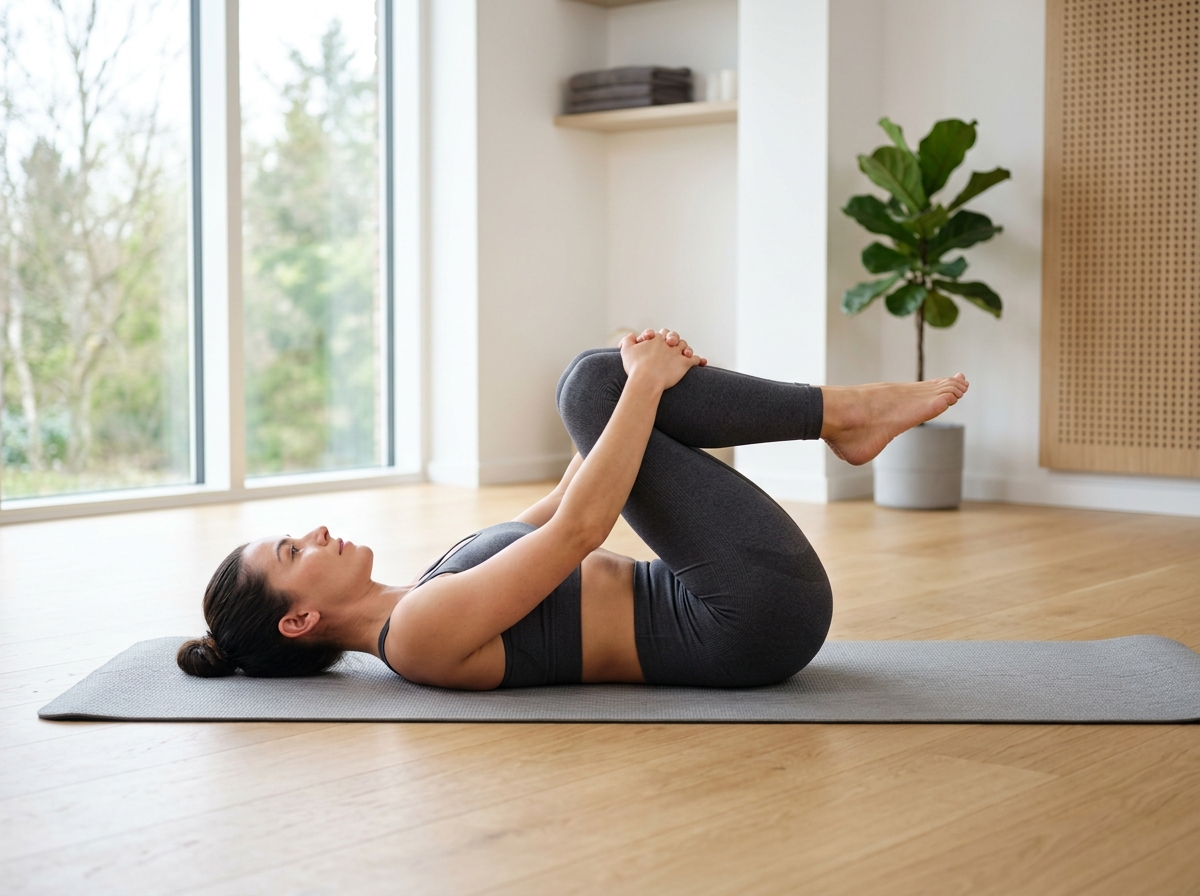
Double Knee-to-Chest Lumbar Hug
Drawing both knees into the chest creates complete lumbar flexion in a non-weight-bearing supine position. This maximizes intervertebral foramen diameter, offering immediate relief for spinal stenosis and lower back spasm.
Step-by-Step Execution
CLINICAL PROTOCOL- 1 Lie flat on your back on a supportive mat or firm bed with legs extended.
- 2 Bring both knees up toward your chest one at a time.
- 3 Wrap your arms around your shins or behind your thighs and gently hug your knees toward your ribs.
- 4 Gently rock side to side slightly if comfortable to provide a soothing massage across your sacrum and lower back.
- 5 Hold for 30 to 45 seconds while focusing on slow abdominal exhalations.
KEY FORM CUES
- ✓ Clasp hands behind your knees (hamstrings) if you have sensitive kneecaps or knee osteoarthritis.
- ✓ Keep your head and shoulder blades relaxed on the mat.
MISTAKES TO AVOID
- ✗ Do not lift your head and neck up toward your knees (keep upper body relaxed).
- ✗ Avoid jerking both legs up simultaneously if experiencing acute spasm.
CONTRAINDICATIONS & WHEN TO AVOID
Do not perform this movement or modify strictly under clinical supervision if you have:
- Acute posterior disc herniation (flexion may increase posterior disc protrusion)
Clinical Biomechanics & Evidence
This exercise protocol utilizes proven spinal mechanics: active core co-contraction (McGill stabilization), directional preference extension (McKenzie MDT), and non-compressive axial elongation to facilitate nutrient exchange in the avascular intervertebral disc matrix.
Conditions Treated by This Exercise
Related Spine Rehabilitation Exercises
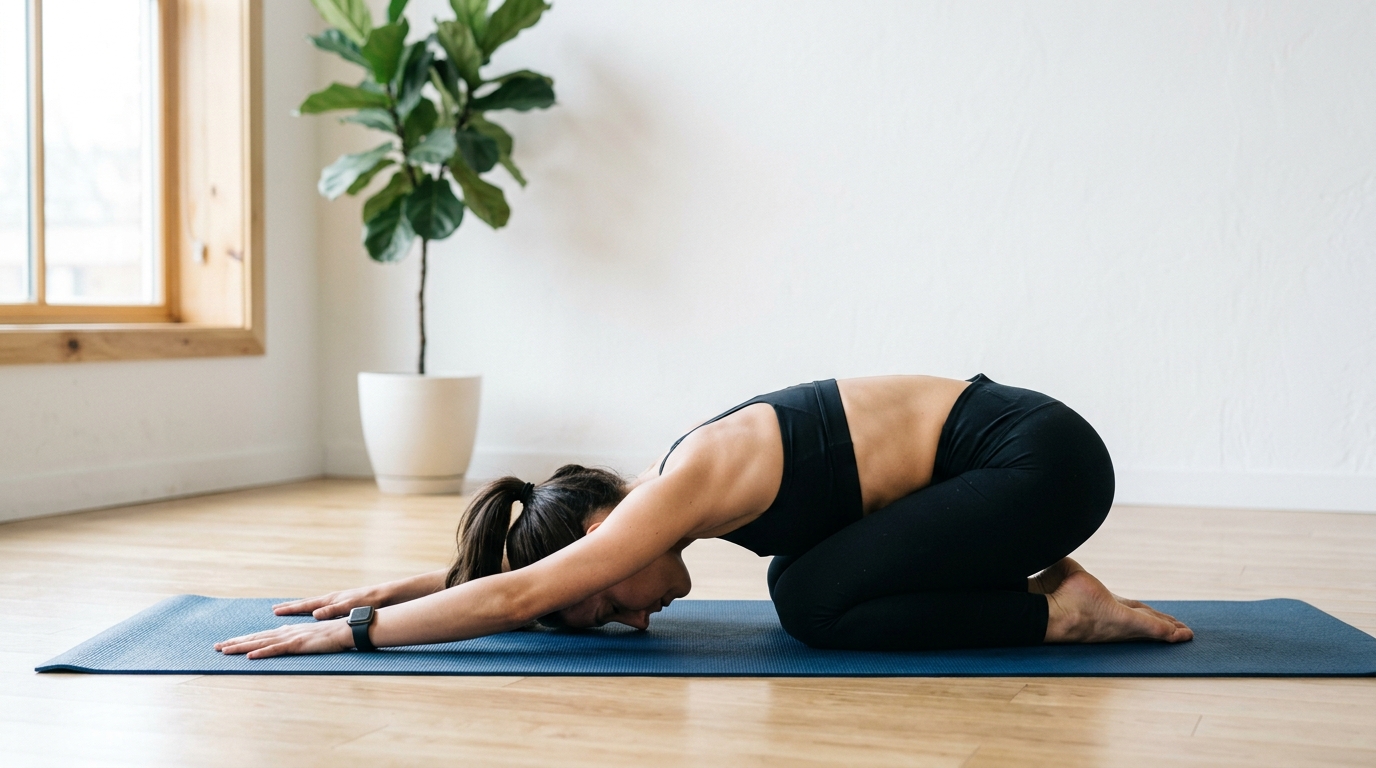
Supported Child’s Pose (Balasana)
Gentle spine elongation that decompresses lumbar vertebrae and releases tight latissimus dorsi.
Cat-Cow Spinal Waves
Synchronized flexion and extension to lubricate intervertebral discs and restore spine mobility.
Glute Bridge Pelvic Stabilization
Activates inhibited gluteals and posterior chain to remove excessive load from lumbar extensors.