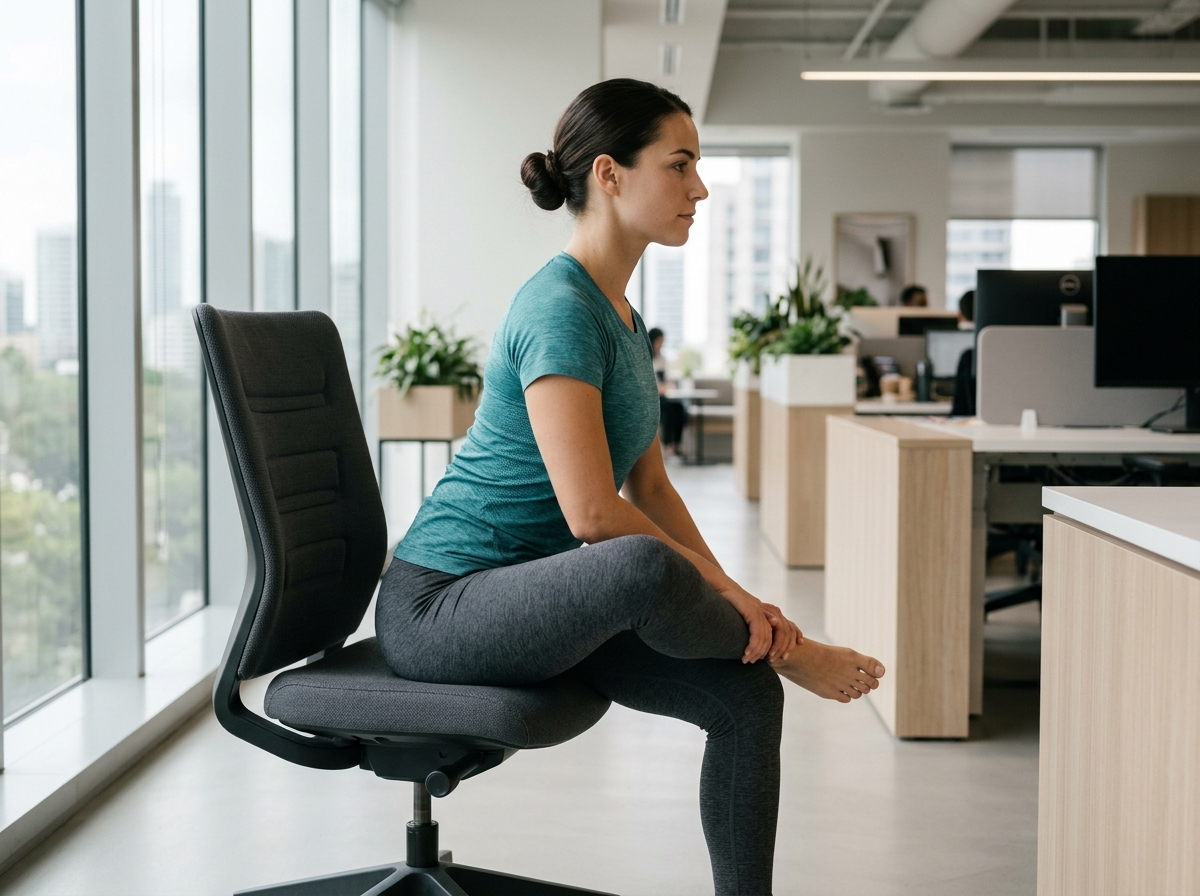
Seated Desk Piriformis Release
Ideal for desk workers suffering from deep glute ache and pseudo-sciatica. Cross-body hip external rotation stretches the piriformis and obturator muscles without needing a floor mat.
Step-by-Step Execution
CLINICAL PROTOCOL- 1 Sit tall on the front half of your chair with feet flat on the floor.
- 2 Cross your right ankle over your left knee, resting the ankle bone just above the kneecap.
- 3 Flex your right foot (toes toward shin) and let your right knee relax outward toward the floor.
- 4 Inhale to lengthen your spine tall, then exhale and hinge forward from your hips with a flat back.
- 5 Hold for 30 seconds as you feel a soothing stretch in your right buttock. Switch and repeat on the left.
KEY FORM CUES
- ✓ Hinge strictly from your hips while keeping your chest proud and spine long (do not hunch or slouch forward).
- ✓ Apply light downward pressure on your right thigh with your forearm if you need a deeper stretch.
MISTAKES TO AVOID
- ✗ Do not round your shoulders or collapse your thoracic spine.
- ✗ Avoid pushing directly onto your knee joint.
CONTRAINDICATIONS & WHEN TO AVOID
Do not perform this movement or modify strictly under clinical supervision if you have:
- Recent hip replacement with posterior dislocation precautions
Clinical Biomechanics & Evidence
This exercise protocol utilizes proven spinal mechanics: active core co-contraction (McGill stabilization), directional preference extension (McKenzie MDT), and non-compressive axial elongation to facilitate nutrient exchange in the avascular intervertebral disc matrix.
Conditions Treated by This Exercise
Related Spine Rehabilitation Exercises
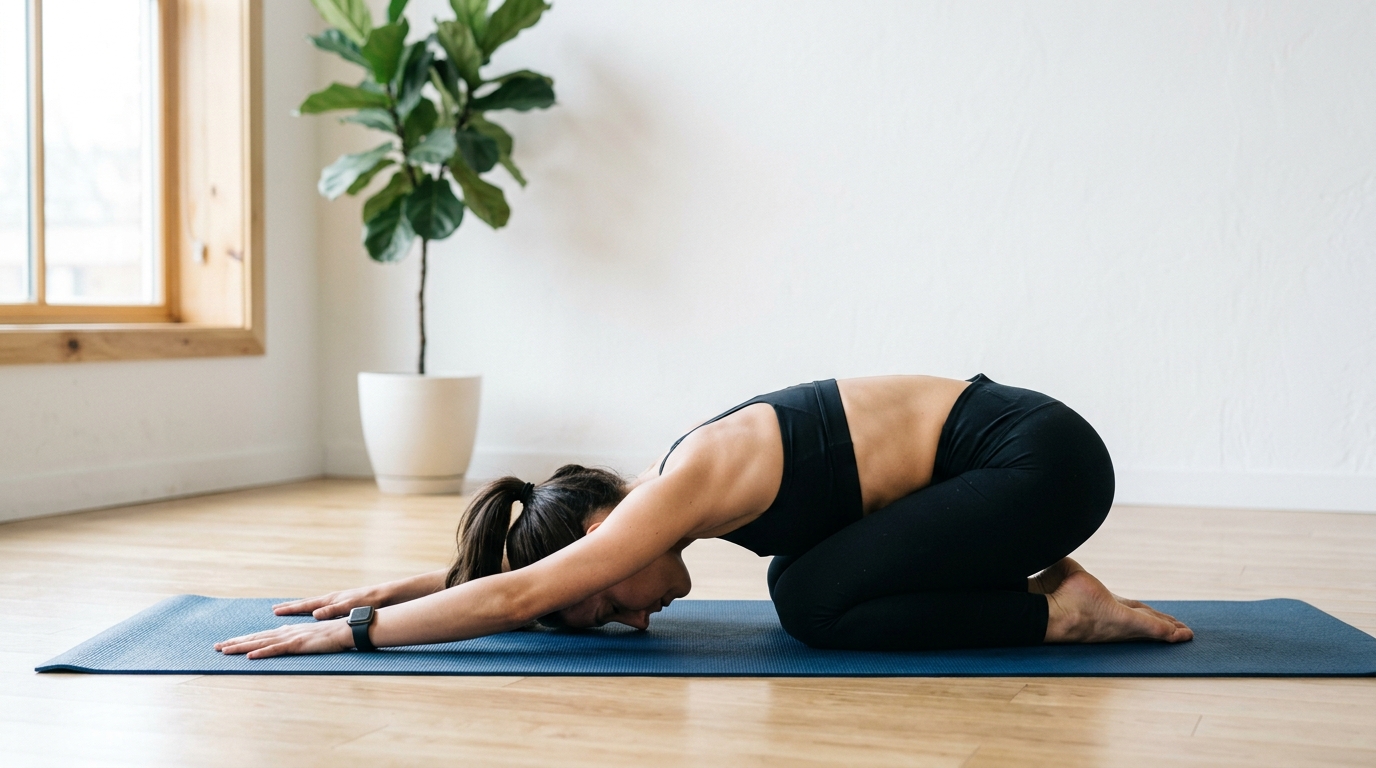
Supported Child’s Pose (Balasana)
Gentle spine elongation that decompresses lumbar vertebrae and releases tight latissimus dorsi.
Cat-Cow Spinal Waves
Synchronized flexion and extension to lubricate intervertebral discs and restore spine mobility.
Reclined Figure-4 Piriformis Stretch
Releases the deep piriformis muscle to relieve sciatic nerve impingement and glute ache.