DESK RELIEF Chair / Seated • Beginner
Discs: T1-T2, T2-T3, T3-T4, T4-T5, T5-T6
Seated Eagle Arms Interscapular Opener
Adapted from yoga’s Garudasana, Eagle Arms creates active protraction and cross-body stretching across the upper thoracic spine (T1-T6). It directly elongates hypertonic rhomboids and middle trapezius fibers that spasm during long typing sessions.
BIOMECHANICAL MOVEMENT DIAGRAM
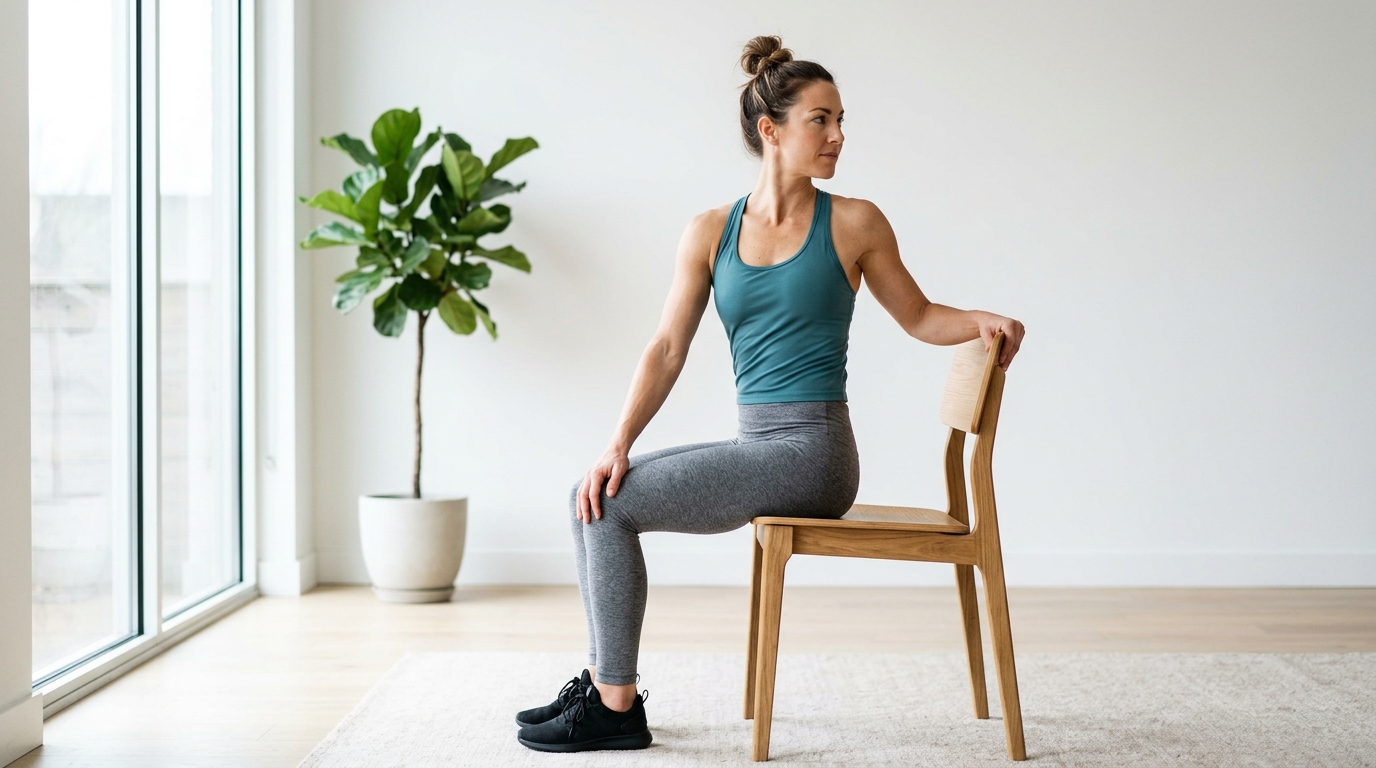
SEATED EAGLE ARMS RHOMBOID
🎯 Desk Knot & Scapular Release
Step-by-Step Execution
CLINICAL PROTOCOL- 1 Sit upright in your chair with feet flat and spine elongated.
- 2 Extend both arms straight forward at shoulder height.
- 3 Cross your right arm over your left arm at the elbows, bending both elbows so forearms are vertical.
- 4 Wrap your forearms around each other, pressing your palms together (or backs of hands if tight).
- 5 Gently lift your elbows upward toward shoulder height and push your forearms slightly forward away from your face.
- 6 Hold for 25 seconds while taking deep breaths into your upper back. Unwind and switch arms.
🎯
KEY FORM CUES
- ✓ Lift your elbows up while simultaneously pressing your shoulder blades down.
- ✓ Breathe deeply to expand your ribs and widen the space between your shoulder blades.
⚠️
MISTAKES TO AVOID
- ✗ Do not shrug your shoulders up into your ears.
- ✗ Avoid slouching or rounding your lower back.
🛑
CONTRAINDICATIONS & WHEN TO AVOID
Do not perform this movement or modify strictly under clinical supervision if you have:
- Severe shoulder impingement or anterior labral tear
SCIENTIFIC FOUNDATIONS & CITATIONS
Clinical Biomechanics & Evidence
This exercise protocol utilizes proven spinal mechanics: active core co-contraction (McGill stabilization), directional preference extension (McKenzie MDT), and non-compressive axial elongation to facilitate nutrient exchange in the avascular intervertebral disc matrix.
• McGill, S.M. (2016). Low Back Disorders: Evidence-Based Prevention and Rehabilitation. Human Kinetics.
• Delitto, A., et al. (2021). Low Back Pain Clinical Practice Guidelines. Journal of Orthopaedic & Sports Physical Therapy (JOSPT).
CLINICAL DOSAGE
Hold Duration 25 Seconds
Repetitions 2 holds each arm cross
Prescription Sets 1 set
Difficulty Beginner
Position Chair / Seated
TARGET MUSCLES
Rhomboids Middle Trapezius Posterior Deltoid
STABILIZER MUSCLES
Infraspinatus Upper Thoracic Spine