DESK RELIEF Chair / Seated • Gentle
Discs: T4-T5, T5-T6, T6-T7, T7-T8, T8-T9, T9-T10, T10-T11, T11-T12, T12-L1, L1-L2
Seated Office Chair Spinal Twist
Sitting for hours locks the thoracic spine and shortens the quadratus lumborum (QL). This seated twist restores rotational mobility in the mid-back so the lower back does not bear excessive rotational strain.
BIOMECHANICAL MOVEMENT DIAGRAM
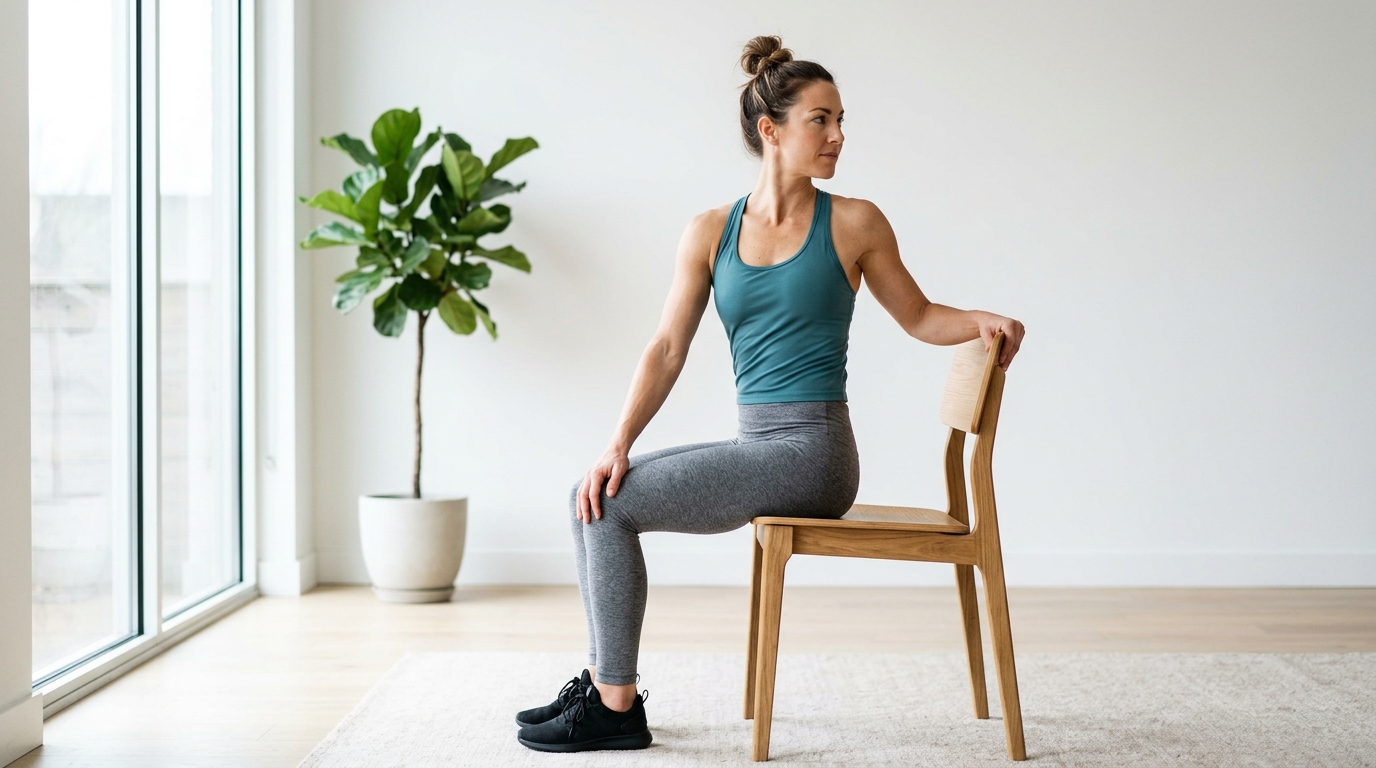
DESK ROTATION RESET
🎯 Thoracic & QL
Step-by-Step Execution
CLINICAL PROTOCOL- 1 Sit tall on the edge of a sturdy chair with both feet flat on the floor, knees at 90 degrees.
- 2 Inhale to lengthen your spine toward the ceiling.
- 3 Exhale and gently twist your torso to the right, placing your left hand on the outside of your right knee.
- 4 Place your right hand on the back of the chair to support the gentle twist.
- 5 Hold for 20 seconds, breathing evenly. Return to center on an inhale and repeat to the left.
🎯
KEY FORM CUES
- ✓ Initiate rotation from your upper/mid back rather than wrenching your lower back.
- ✓ Keep both sit-bones firmly rooted on the chair surface.
⚠️
MISTAKES TO AVOID
- ✗ Do not use arm force to violently pull yourself into a deep twist.
- ✗ Avoid slouching or rounding your shoulders while twisting.
🛑
CONTRAINDICATIONS & WHEN TO AVOID
Do not perform this movement or modify strictly under clinical supervision if you have:
- Acute facet joint lock or rib subluxation
SCIENTIFIC FOUNDATIONS & CITATIONS
Clinical Biomechanics & Evidence
This exercise protocol utilizes proven spinal mechanics: active core co-contraction (McGill stabilization), directional preference extension (McKenzie MDT), and non-compressive axial elongation to facilitate nutrient exchange in the avascular intervertebral disc matrix.
• McGill, S.M. (2016). Low Back Disorders: Evidence-Based Prevention and Rehabilitation. Human Kinetics.
• Delitto, A., et al. (2021). Low Back Pain Clinical Practice Guidelines. Journal of Orthopaedic & Sports Physical Therapy (JOSPT).
CLINICAL DOSAGE
Hold Duration 20 Seconds
Repetitions 3 holds each side
Prescription Sets 1 set
Difficulty Gentle
Position Chair / Seated
TARGET MUSCLES
Thoracic Rotators Internal/External Obliques Quadratus Lumborum
STABILIZER MUSCLES
Rhomboids Erector Spinae