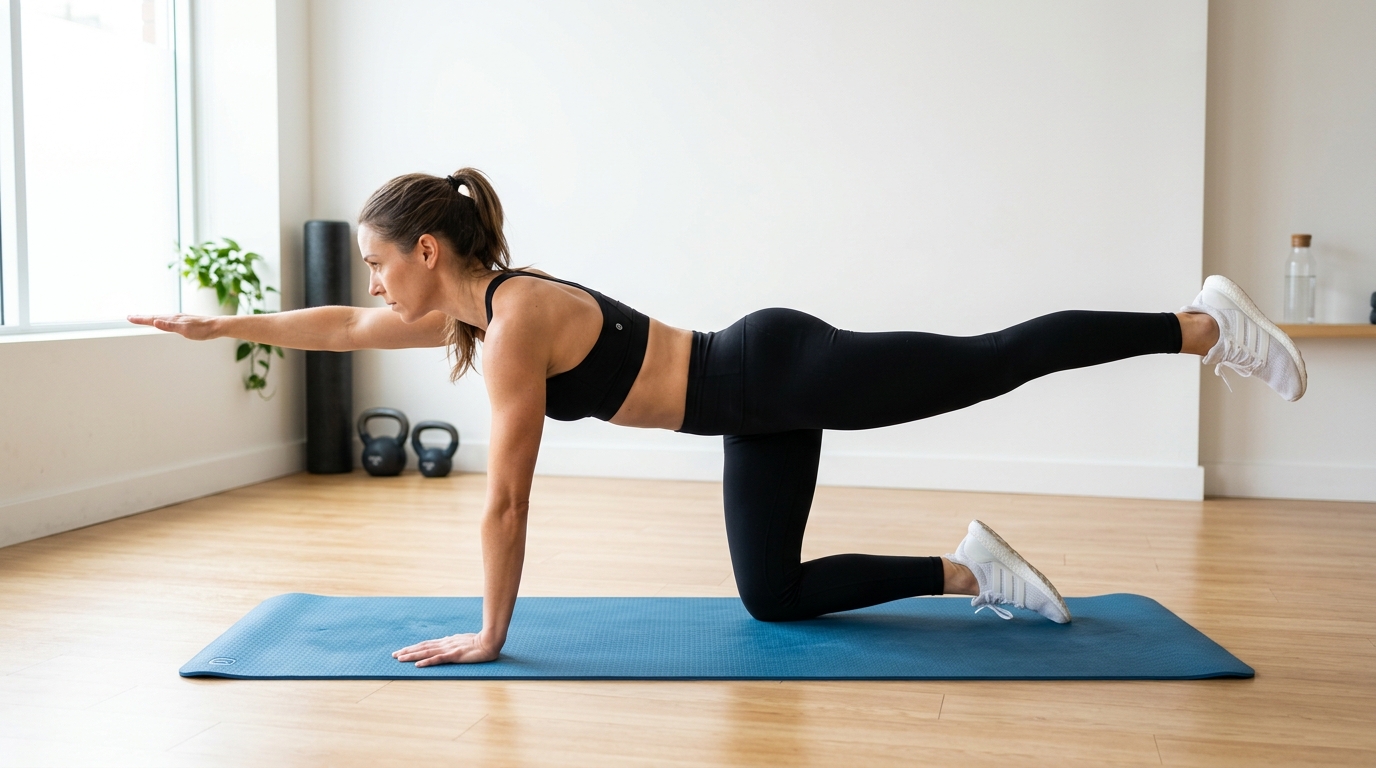
Bird-Dog McGill Stabilization
Designed by spine biomechanics pioneer Dr. Stuart McGill, the Bird-Dog challenges rotational stability and trains the posterior oblique sling (latissimus dorsi + contralateral gluteus maximus) while keeping the spine in a safe neutral position.
Step-by-Step Execution
CLINICAL PROTOCOL- 1 Start on all fours with hands directly under shoulders and knees under hips. Keep your spine in a neutral tabletop.
- 2 Brace your abdominal wall lightly without holding your breath.
- 3 Simultaneously reach your right arm straight forward and kick your left leg straight back until parallel to the floor.
- 4 Hold the outstretched position for 5 seconds while keeping your hips level like a tray of drinks.
- 5 Return to tabletop under control and repeat with the opposite arm and leg (left arm, right leg).
KEY FORM CUES
- ✓ Imagine balancing a cup of water on your lower back; do not let your hips twist or dip.
- ✓ Kick through the heel with toes pointing down to engage the glute rather than the lower back.
MISTAKES TO AVOID
- ✗ Do not lift your arm or leg too high, which causes excessive lumbar hyperextension.
- ✗ Avoid rotating the pelvis open toward the ceiling.
CONTRAINDICATIONS & WHEN TO AVOID
Do not perform this movement or modify strictly under clinical supervision if you have:
- Severe acute rotator cuff tear or shoulder impingement
Clinical Biomechanics & Evidence
This exercise protocol utilizes proven spinal mechanics: active core co-contraction (McGill stabilization), directional preference extension (McKenzie MDT), and non-compressive axial elongation to facilitate nutrient exchange in the avascular intervertebral disc matrix.
Conditions Treated by This Exercise
Herniated & Bulging Lumbar Disc
Evidence-Based Extension Protocols to Centralize Disc Material
Desk Worker & Sitting Posture Ache
Combat "Glute Amnesia", Tight Hip Flexors, and Rounded Shoulders
Sacroiliac (SI) Joint Dysfunction
Restore Pelvic Alignment and Rebalance Pelvic Stabilizer Muscles
Rhomboid & Interscapular Pain
Release Chronic Knots and Trigger Point Spasms Between Shoulder Blades
Related Spine Rehabilitation Exercises
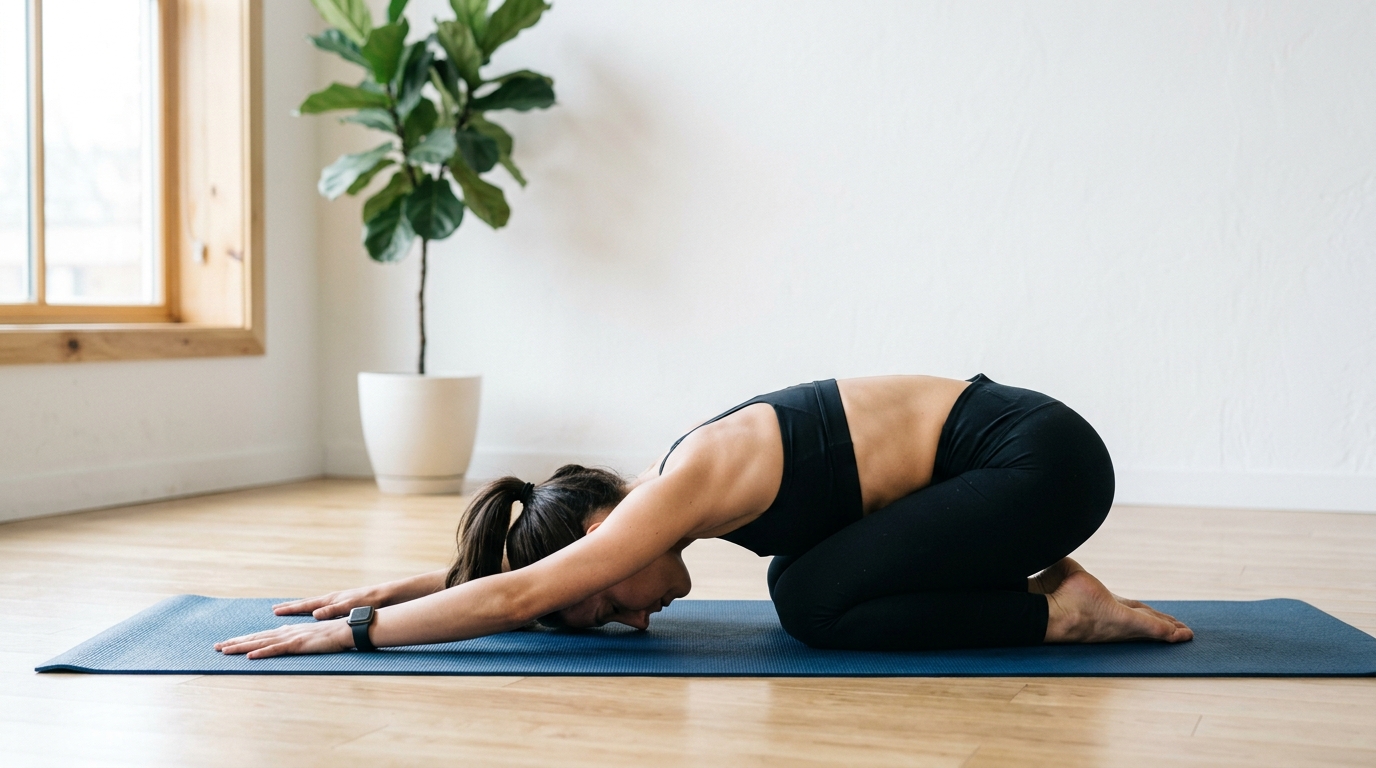
Supported Child’s Pose (Balasana)
Gentle spine elongation that decompresses lumbar vertebrae and releases tight latissimus dorsi.
Cat-Cow Spinal Waves
Synchronized flexion and extension to lubricate intervertebral discs and restore spine mobility.
Reclined Figure-4 Piriformis Stretch
Releases the deep piriformis muscle to relieve sciatic nerve impingement and glute ache.