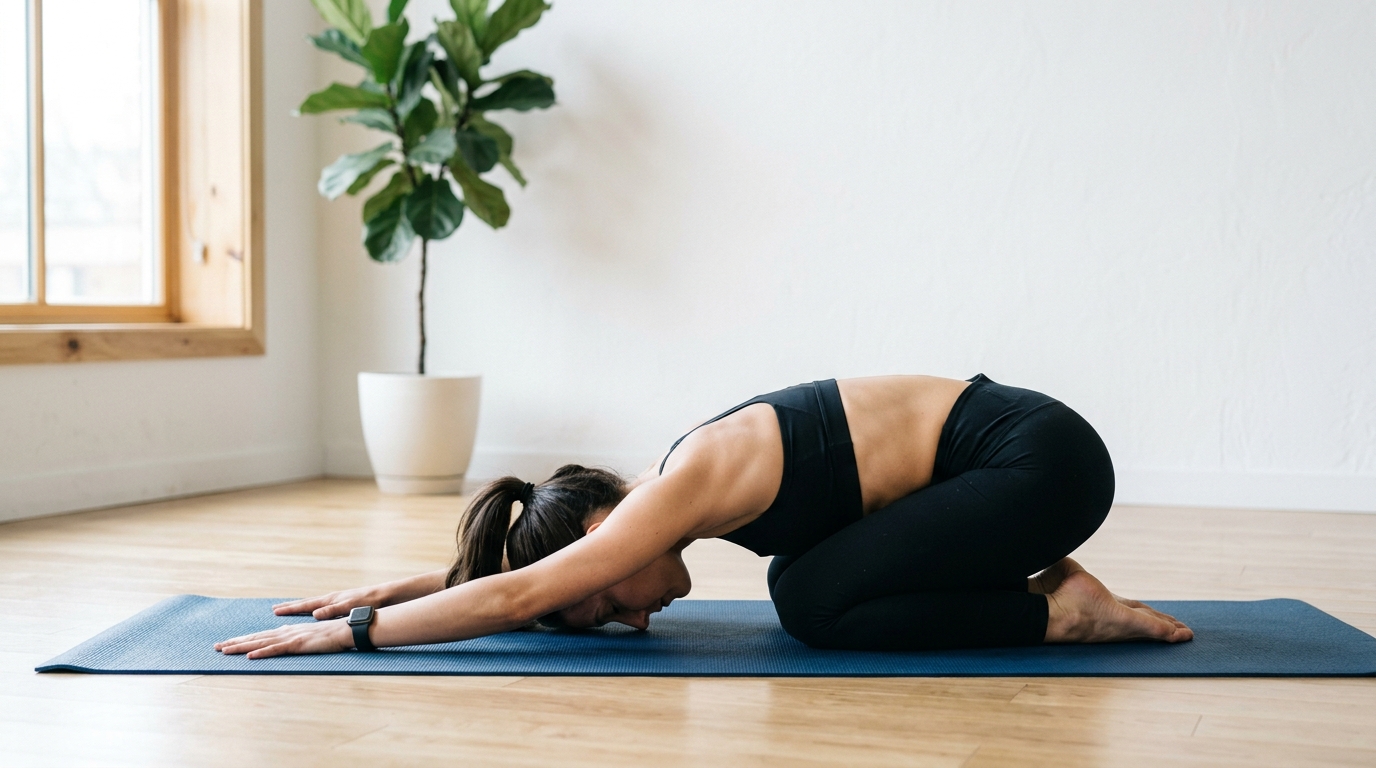
KRÄFTIGUNG Bodenmatte • Anfänger
Discs: L3-L4, L4-L5, L5-S1
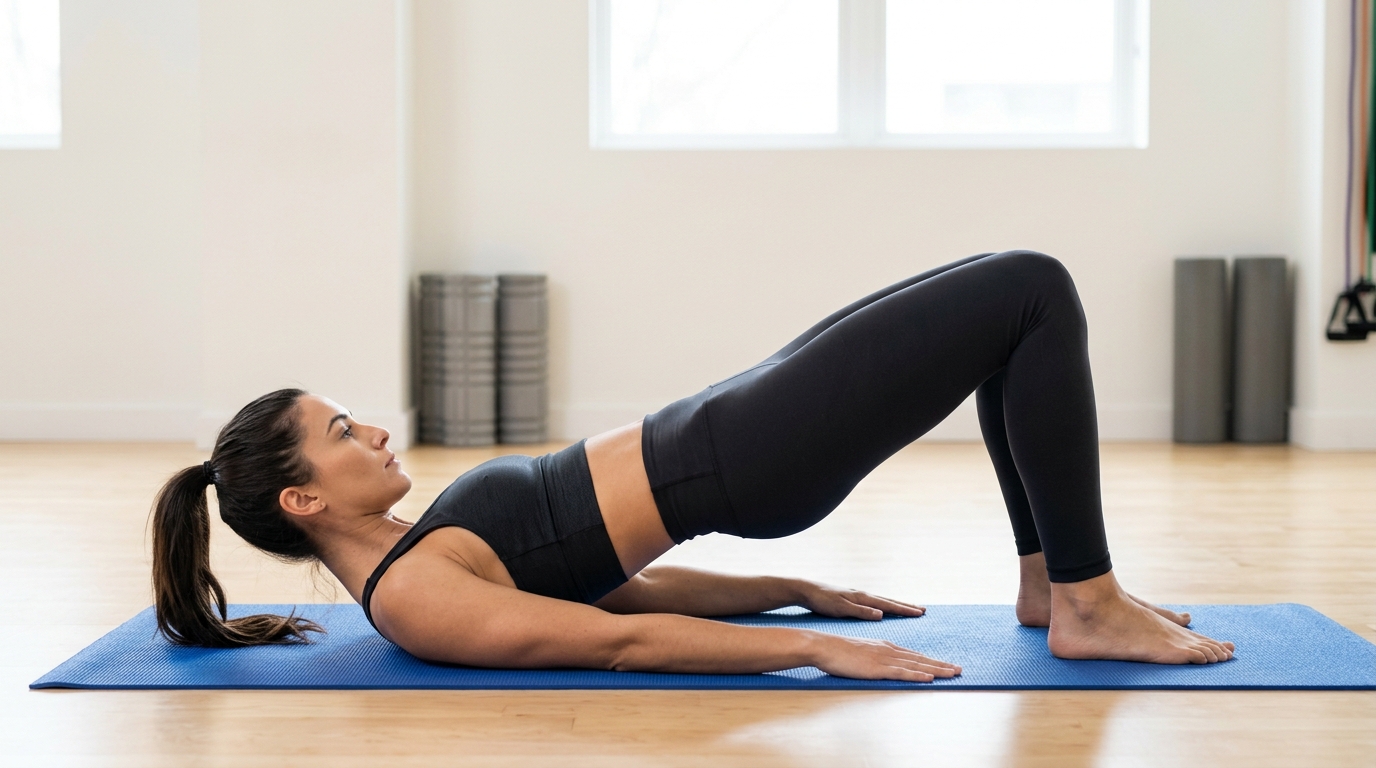
Glute Bridge zur LWS- & Beckenstabilisierung
Prolonged sitting causes "gluteal amnesia" where hip extensors fail to fire, forcing the lower back to compensate. The glute bridge trains hip extension through the glutes while stabilizing the lumbar spine and pelvis.
BIOMECHANISCHES BEWEGUNGSDIAGRAMM
GLUTE & PELVIC STABILITY
🎯 Posterior Chain
Schritt-für-Schritt Ausführung
KLINISCHES PROTOKOLL- 1 Lie on your back with knees bent, feet flat on the floor hip-width apart, and arms by your sides.
- 2 Engage your abdominal core as if bracing for a light punch.
- 3 Drive through your heels to lift your hips toward the ceiling until knees, hips, and shoulders form a straight diagonal line.
- 4 Squeeze your glutes tightly at the top for 3 seconds without over-arching your lower back.
- 5 Slowly lower your hips back down with control. Complete 10 to 12 repetitions.
🎯
WICHTIGE HALTUNGS-HINWEISE
- ✓ Drive power through your heels, not your toes.
- ✓ Ensure the lift comes from the glutes, not by hyperextending your lumbar spine.
⚠️
HÄUFIGE FEHLER
- ✗ Do not flare your ribs or overarch your lower back at top.
- ✗ Do not let your knees collapse inward.
🛑
KONTRAINDIKATIONEN & WARNUNGEN
Do not perform this movement or modify strictly under clinical supervision if you have:
- Acute abdominal hernia
- Severe spinal stenosis aggravated by extension
WISSENSCHAFTLICHE GRUNDLAGEN & QUELLEN
Klinische Biomechanik & Evidenz
This exercise protocol utilizes proven spinal mechanics: active core co-contraction (McGill stabilization), directional preference extension (McKenzie MDT), and non-compressive axial elongation to facilitate nutrient exchange in the avascular intervertebral disc matrix.
• McGill, S.M. (2016). Low Back Disorders: Evidence-Based Prevention and Rehabilitation. Human Kinetics.
• Delitto, A., et al. (2021). Low Back Pain Clinical Practice Guidelines. Journal of Orthopaedic & Sports Physical Therapy (JOSPT).
KLINISCHE DOSIERUNG
Haltedauer 3 Seconds
Wiederholungen 12 reps
Empfohlene Sätze 3 sets
Schwierigkeit Anfänger
Ausgangsposition Bodenmatte
ZIELMUSKELN
Gluteus Maximus Hamstrings
STABILISIERENDE MUSKELN
Transverse Abdominis Multifidus Quadriceps