CERVICAL SPINE Chair / Seated • Gentle
Discs: C2-C3, C3-C4, C4-C5, C5-C6, C6-C7, C7-T1
Chin Tucks (Retração Cervical para Correção Postural)
For every inch the head migrates forward, the cervical spine bears an extra 10 lbs of weight. McKenzie chin tucks restore axial alignment, open compressed suboccipital nerve spaces, and decompress the C5-C6 and C6-C7 disc segments.
DIAGRAMA BIOMECÂNICO DO MOVIMENTO
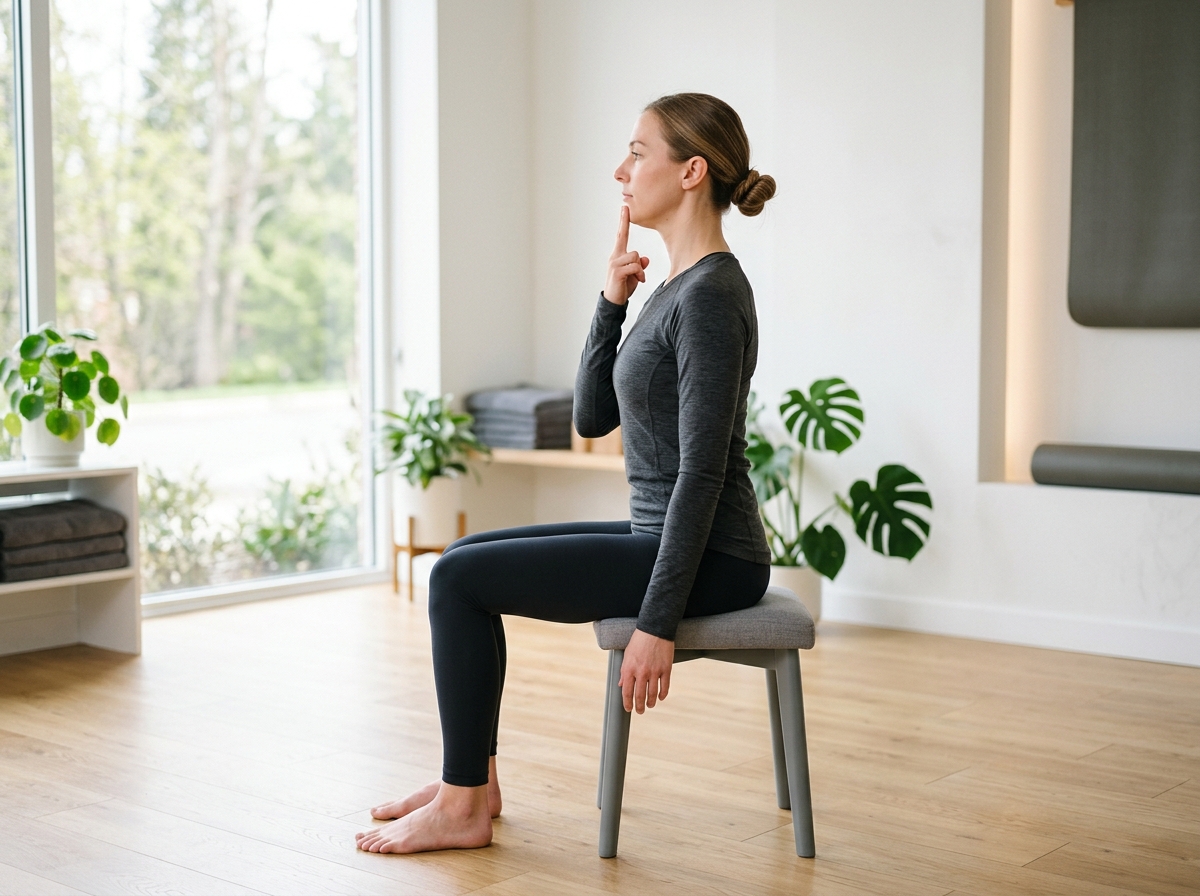
MCKENZIE CERVICAL RETRACTION
🎯 C1-C7 Tech Neck Reset
Execução Passo a Passo
PROTOCOLO CLÍNICO- 1 Sit or stand tall with shoulders relaxed and gaze straight ahead at eye level.
- 2 Place two fingers on your chin.
- 3 Without tilting your head up or down, gently glide your chin straight backward as if making a "double chin".
- 4 Feel a gentle elongation and stretch along the base of your skull and back of your neck.
- 5 Hold for 3 to 5 seconds, then release back to neutral. Perform 10 to 12 smooth repetitions.
🎯
PONTOS-CHAVE DE POSTURA
- ✓ Imagine your head sliding straight back along a horizontal track like a cash register drawer.
- ✓ Keep your eyes fixed forward; do not look down toward your chest.
⚠️
ERROS A EVITAR
- ✗ Do not bend your neck downward (this is cervical flexion, not retraction).
- ✗ Avoid jamming your chin back with excessive force.
🛑
CONTRAINDICAÇÕES E QUANDO EVITAR
Do not perform this movement or modify strictly under clinical supervision if you have:
- Acute severe cervical whiplash within 72 hours of injury
- Vertebrobasilar insufficiency (dizziness/nausea with neck movement)
FUNDAMENTOS CIENTÍFICOS & CITAÇÕES
Biomecânica Clínica & Evidências
This exercise protocol utilizes proven spinal mechanics: active core co-contraction (McGill stabilization), directional preference extension (McKenzie MDT), and non-compressive axial elongation to facilitate nutrient exchange in the avascular intervertebral disc matrix.
• McGill, S.M. (2016). Low Back Disorders: Evidence-Based Prevention and Rehabilitation. Human Kinetics.
• Delitto, A., et al. (2021). Low Back Pain Clinical Practice Guidelines. Journal of Orthopaedic & Sports Physical Therapy (JOSPT).
DOSAGEM CLÍNICA
Tempo de Sustentação 5 Seconds
Repetições 10-12 repetitions
Séries Prescritas 2 sets
Dificuldade Gentle
Posição Chair / Seated
MÚSCULOS ALVO
Longus Colli Longus Capitis (Deep Neck Flexors)
MÚSCULOS ESTABILIZADORES
Suboccipitals Upper Trapezius Sternocleidomastoid